The Keto and Paleo diets are two of the most popular eating plans to boost weight loss, improve metabolic health, and reduce processed foods, but they differ in several important ways. While both allow whole, nutritious foods and limit refined carbohydrates and added sugars, the Keto Diet aims to induce ketosis by lowering carbohydrate intake, whereas the Paleo Diet focuses on foods eaten by our hunter-gatherer ancestors without carb restriction. So, which diet is better? Let’s compare Keto vs. Paleo to find out!
Key Takeaways
Keto is a very low-carbohydrate, high-fat diet that induces ketosis.
Paleo emphasizes whole, minimally processed foods without requiring ketosis or macronutrient tracking.
Both diets exclude refined grains, added sugars, and many ultra-processed foods.
Keto can provide faster short-term weight loss and greater improvements in blood sugar.
Paleo generally allows more fruits and starchy vegetables, making it more flexible and easier to maintain.
The best diet is the one that supports your health goals and nutritional needs in the long term.
A Sneak Peek Into Keto vs. Paleo
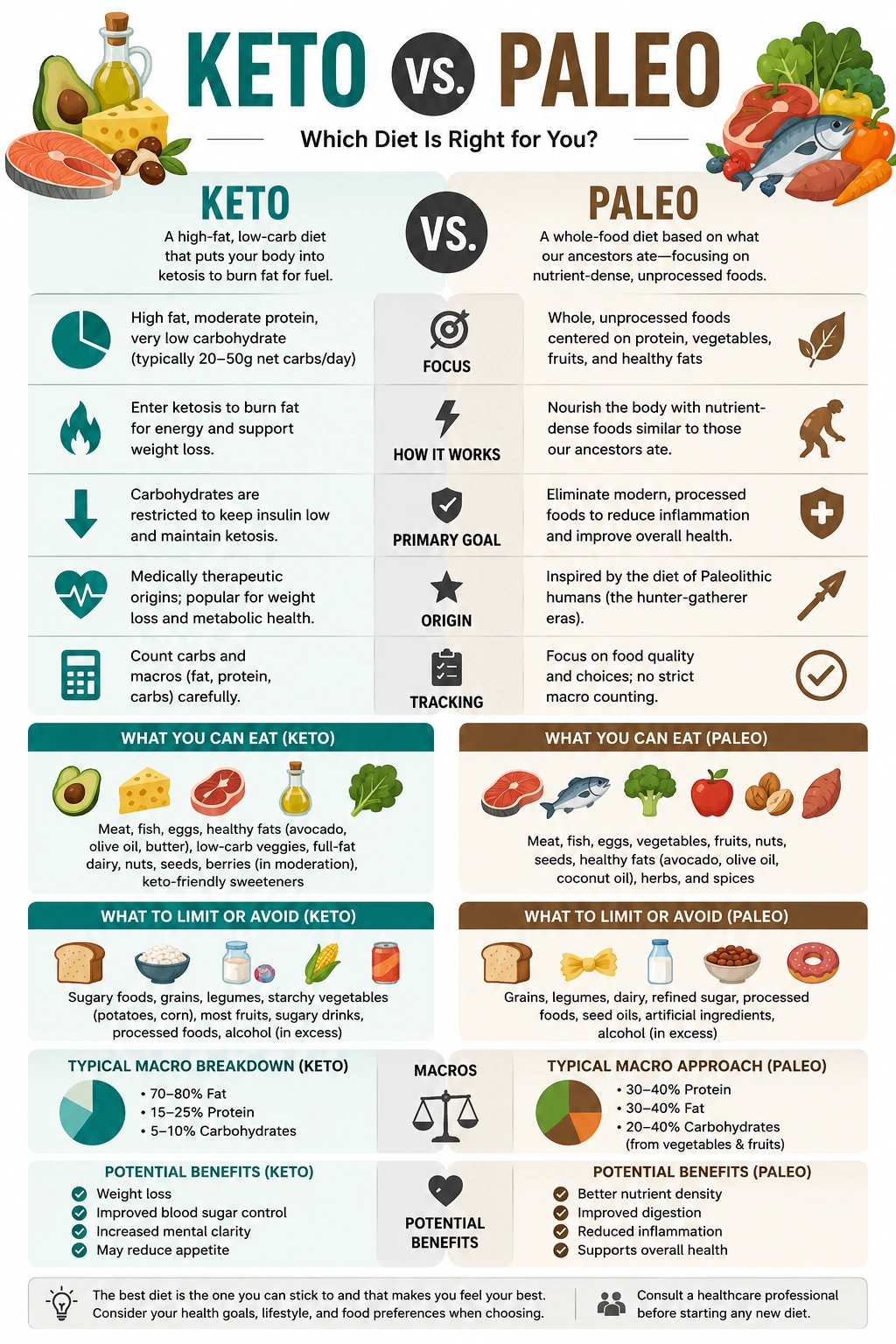
Before going into details, let’s look at the table below, which compares Keto vs. Paleo, gives the big picture, and helps you understand which diet may be better for you.
Feature
Keto Diet
Paleo Diet
Main Goal
Achieve nutritional ketosis
Eat whole, ancestral foods
Daily Carbohydrates
Usually 20-50 g net carbs
No fixed limit
Fat Intake
Very high (about 70-75 percent of calories)
Moderate to high
Protein Intake
Moderate
Moderate to high
Fruits
Limited
Most fruits allowed
Starchy Vegetables
Usually avoided
Allowed
Dairy
Many full-fat options allowed
Usually excluded
Grains
Not allowed
Not allowed
Legumes
Not allowed
Not allowed
Processed Foods
Minimized
Strongly discouraged
Typical Weight Loss
Often rapid initially
Gradual and sustainable
Easier to Follow Long-Term
Moderate
Generally easier
Bottom Line:
Choose Keto if your goal is ketosis, limiting carbohydrates, or improving blood sugar under proper medical care. Choose Paleo if you want a flexible whole-food lifestyle without tracking carbohydrates.
The Ketogenic or Keto Diet is a high-fat, very low-carbohydrate diet that shifts your body's main energy source from glucose to fat.
When you eat a lot fewer carbohydrates, your liver produces molecules called ketones, which provide energy for the brain and many other tissues. This metabolic state is known as ketosis [1].
While the exact ratio of macronutrients (fat, protein, and carbohydrates) is completely personal, a standard ketogenic diet usually sources calories in the following order:
Fat: 70-75% of daily calories
Protein: 20-25% of daily calories
Carbohydrates: 5-10% of daily calories
You can decide on the right level of carbs based on your metabolic flexibility. You can also use this free Carnivore Macro Calculator to find the right balance of macronutrients based on your age, gender, and activity level.
To stay in ketosis, most people limit their intake to 20-50 grams of net carbohydrates per day, though individual needs vary based on factors such as activity level, body composition, and metabolic health.
You can provide these daily calories and macronutrients from the following sources.
Contain hidden sugars that can quickly increase daily carb intake
Avoiding these foods and consuming those allowed can provide macronutrients that lead to different health benefits for those following a low-carb ketogenic diet.
Various research studies suggest the ketogenic diet can help [2] [3]:
Promote short-term weight loss
Improve blood sugar control in people with type 2 diabetes
Reduce appetite by increasing satiety
Lower triglyceride levels
Increase HDL (good) cholesterol in many individuals
Support treatment of drug-resistant epilepsy under medical supervision
Despite these important health benefits, a Keto Diet can come with certain challenges and risks.
Possible Challenges of Keto Diet
The keto diet may also present challenges, especially during the first few weeks:
Keto flu
Electrolyte imbalances
Constipation
Difficulty eating out
Limited fruit and whole-grain intake
Potential nutrient gaps if meals are not properly planned
Now that we have learned the basics about the Keto Diet, let’s learn about the Paleo Diet to be able to compare Keto vs. Paleo so you can make the best choice.
The Paleo or Paleolithic Diet is based on the idea of eating foods similar to those consumed by early humans before modern agriculture.
Instead of focusing on ketosis or limiting carbohydrates, Paleo allows whole, minimally processed foods and excludes foods introduced during farming and industrial food production [4] [5].
Unlike Keto, on a Paleo Diet, you do not need to count carbohydrates, track ketones, or meet specific macronutrient targets. You can also consume a wide range of foods on a Paleo Diet.
Common Foods on a Paleo Diet
The table below shows the most common foods you are allowed to consume on a Paleo Diet.
Increase fiber intake compared with many low-carb diets
Provide a wide variety of vitamins, minerals, and antioxidants
Challenges and Risks of a Paleo Diet
Some of the most common drawbacks of a Paleo Diet include:
Excluding dairy, which can reduce calcium intake
Eliminating legumes and whole grains, which are nutritious for many people
Higher grocery costs due to focusing on fresh foods and quality proteins
Less suitable for strict vegetarians or vegans
Now that we have also learned about the basics of the Paleo Diet, let’s compare Keto vs. Paleo, check their similarities and differences to make the best decision.
Keto vs. Paleo: Which Diet Is Better for Losing Weight?
Both the Keto and Paleo diets can support weight loss, but they do so through different mechanisms.
You can experience short-term weight loss faster on Keto because it significantly reduces carbohydrate intake and can suppress appetite during ketosis.
Paleo usually leads to gradual, sustainable weight loss by focusing on whole foods and reducing calorie intake.
It is important to remember that no diet guarantees weight loss. To lose weight healthily and sustainably, you need to maintain a calorie deficit, eat nutritious foods, get enough protein, and do physical activities.
How Keto Can Promote Weight Loss
Keto can help weight loss by:
Reducing appetite
Increasing satiety due to higher fat and enough protein
Lowering insulin levels, which can influence fat storage
Producing rapid initial weight loss from glycogen and water depletion
Encouraging people to eliminate refined carbohydrates and sugary foods
Increasing fiber intake from fruits and vegetables
Prioritizing lean proteins, which help you feel full
Reducing consumption of added sugars
Encouraging home-cooked meals with minimally processed ingredients
Keto vs. Paleo for Blood Sugar and Diabetes
One of the most common reasons people consider Keto is to improve blood sugar management. Paleo can also help by reducing refined carbohydrates and added sugars, but it generally includes more carbohydrate-rich foods than keto.
Keto and Blood Sugar
A ketogenic diet can help:
Lower blood glucose levels
Reduce blood sugar spikes after meals
Improve insulin sensitivity
Reduce the need for certain diabetes medications under medical supervision
Gut health is influenced by dietary fiber, food diversity, and diet quality.
A Keto Diet can be low in fiber if you do not eat enough vegetables, nuts, and seeds. This may contribute to constipation or reduced microbial diversity. However, a well-planned Keto Diet that includes low-carb vegetables can provide significant amounts of fiber.
On the other hand, because paleo generally allows more fruits and starchy vegetables, it usually provides more dietary fiber and plant variety, both of which support a healthy gut microbiome.
Keto vs. Paleo for Athletes
Athletes have different nutritional needs depending on their sport, training volume, and goals. The table below compares Keto vs Paleo regarding their effects on athletic performance.
Neither Keto nor Paleo is naturally better for building muscle. The best choice depends on whether you can consistently meet your energy and protein needs.
Keto vs. Paleo for PCOS
Some people with polycystic ovary syndrome (PCOS) explore dietary changes to improve insulin resistance and support weight management.
Keto may improve insulin sensitivity and promote weight loss in some individuals, though long-term research is still limited.
Paleo encourages whole foods and reduces added sugars, which may also support metabolic health.
Because PCOS affects people differently, you need to decide on your personalized diet after consulting a healthcare professional.
Both diets can reduce inflammation better than a typical Western diet by:
Eliminating ultra-processed foods
Reducing added sugars
Increasing whole foods
Focusing on healthier fats
Keto vs. Paleo for Brain Health
The Keto Diet can help treat drug-resistant epilepsy under medical supervision. Researchers are also studying its potential role in other neurological conditions, though evidence is still limited.
The Paleo Diet may support brain health indirectly by allowing nutritious foods, healthy fats, fruits, and vegetables, and reducing highly processed foods.
Key takeaway:
Current research suggests that both Keto and Paleo can improve health markers when they emphasize high-quality, minimally processed foods. The most effective diet is usually the one you can follow consistently while meeting your nutritional needs.
Sample 1-Day Keto vs. Paleo Meal Plan
If you want to know what a sample day in your diet can look like, you can check out the table below that shows a sample 1-day meal plan of a Keto vs. Paleo meal plan.
The Keto meal plan focuses on high-fat and very low-carbohydrate intake to maintain ketosis, while the Paleo meal plan focuses on whole, minimally processed foods and includes natural carbohydrate sources like fruits and sweet potatoes without targeting ketosis.
Keto vs. Paleo: Which Diet Is Better for Your Goals?
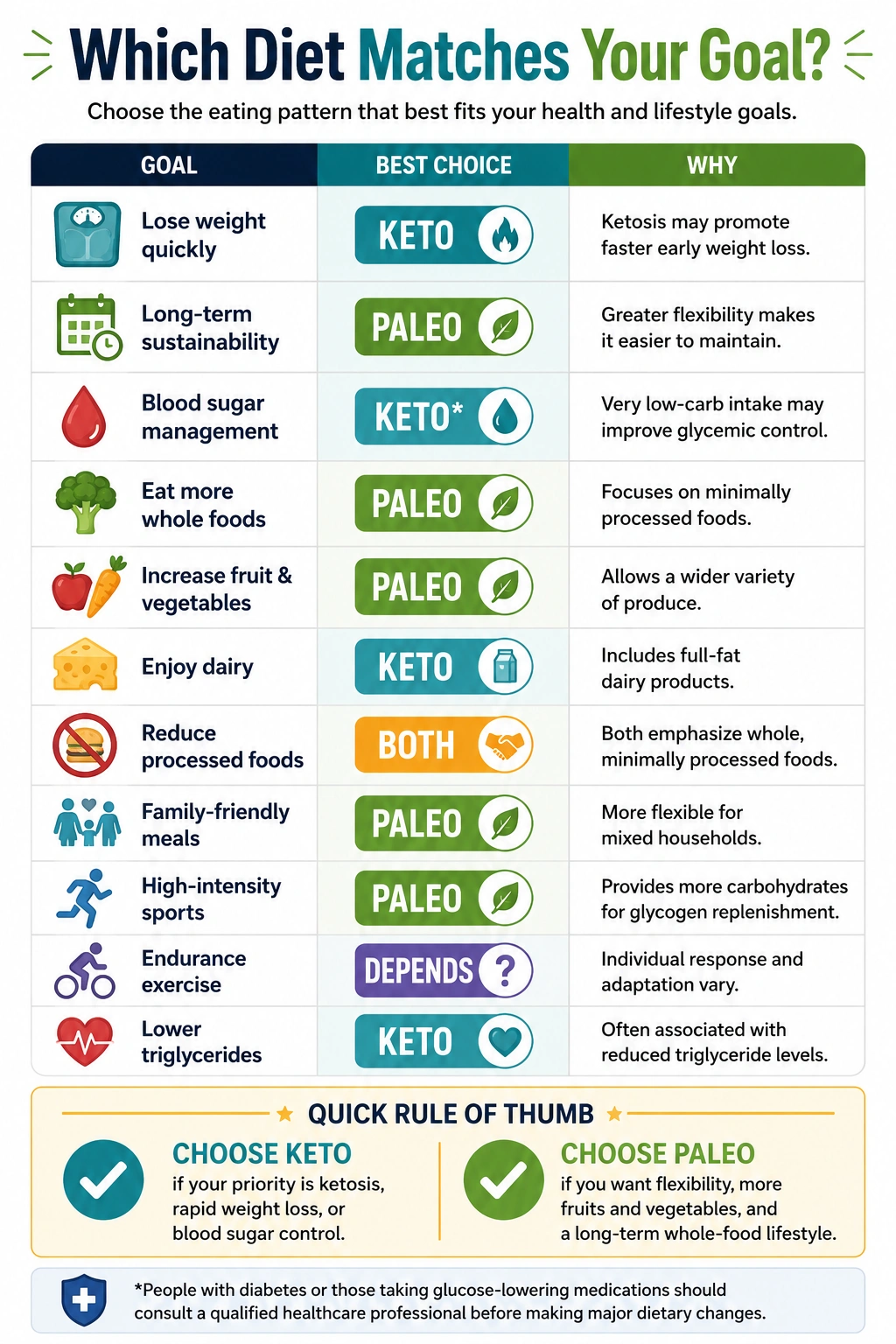
To decide which diet is better for you, you need to consider your goals. The table below summarizes which diet “Keto vs. Paleo” is better for your goals.
Your Goal
Recommended Diet
Why?
Lose weight quickly
Keto
Ketosis and greater carbohydrate restriction may suppress appetite and promote faster early weight loss.
Maintain weight long term
Paleo
Greater flexibility and a wider food selection may make it easier to sustain over time.
Improve blood sugar management
Keto*
Very low carbohydrate intake can reduce post-meal blood sugar and improve glycemic control in some people.
Reduce processed foods
Both
Both diets emphasize whole, minimally processed foods and limit refined products.
Eat more whole foods
Paleo
Allows minimally processed foods, including lean proteins, vegetables, fruits, nuts, and seeds.
Increase fruit and vegetable intake
Paleo
Allows a much wider variety of fruits and starchy vegetables than keto.
Eat more fruit
Paleo
Most fresh fruits fit into a Paleo eating pattern.
Enjoy dairy products
Keto
Full-fat dairy foods such as cheese, butter, and heavy cream are commonly included.
Reduce sugar intake
Either
Both diets discourage added sugars and sugary processed foods.
Prepare family-friendly meals
Paleo
Easier to adapt for households because it is less restrictive and doesn't require ketosis.
Provides more carbohydrates to replenish muscle glycogen and support explosive exercise.
Support endurance exercise
Depends
Some athletes perform well on keto after adaptation, while others benefit from Paleo's higher carbohydrate intake. Individual response varies.
Lower triglyceride levels
Keto
Research suggests ketogenic diets often reduce triglyceride levels, especially in people with metabolic syndrome.
*Important: People with diabetes or those taking glucose-lowering medications should make significant dietary changes under the guidance of a qualified healthcare professional.
The table below lists some of the most common myths about Keto and Paleo and the actual facts.
Myth
Fact
Keto and Paleo are the same diet.
They share some foods but have different goals and rules.
Paleo is automatically low carb.
Paleo can range from low to high carbohydrate depending on food choices.
Keto means eating unlimited bacon and butter.
A well-planned Keto Diet emphasizes nutritious foods and healthy fats.
You cannot eat vegetables on Keto.
Non-starchy vegetables are allowed.
Paleo allows unlimited fruit.
Fruit is allowed, but balance still matters.
Either diet guarantees weight loss.
Sustainable weight loss depends on calorie balance, diet quality, and sticking to the diet.
Dairy is always unhealthy.
Dairy can be a nutritious option for many people unless medically contraindicated or intentionally avoided.
Conclusion
The biggest difference between Keto vs Paleo is how they handle carbohydrates. The Keto Diet is a very low-carbohydrate, high-fat diet that puts your body into ketosis, where fat becomes the main energy source.
In contrast, the Paleo Diet emphasizes eating whole, minimally processed foods that are similar to those available to our hunter-gatherer ancestors.
Paleo excludes grains, legumes, and most processed foods but generally allows more carbohydrates from fruits and starchy vegetables.
Keto can lead to faster short-term weight loss and improve blood sugar control in some individuals, while Paleo is easier to maintain over the long term because it allows a wider variety of whole foods.
The best choice is the one that aligns with your health goals, food preferences, lifestyle, and any medical conditions.
Let’s find answers to the most frequently asked questions about the Keto Diet vs Paleo Diet.
What Is the Main Difference Between Keto and Paleo?
The Keto Diet limits carbohydrates to promote ketosis, while the Paleo Diet focuses on eating whole, minimally processed foods without a specific carbohydrate limit.
Is Keto Better Than Paleo for Weight Loss?
Keto often causes faster initial weight loss, but long-term, sustained weight loss depends more on calorie balance and diet quality than on the diet itself.
Can You Eat Fruit on Keto?
Yes, but only small portions of lower-carbohydrate fruits such as berries are included. Most higher-sugar fruits are limited.
Can You Eat Dairy on Paleo?
Traditional Paleo excludes dairy, although some modern variations allow foods such as ghee.
Many people find Paleo easier because it allows different foods and does not require tracking carbohydrates. Others prefer the clear structure of low-carb Keto.
Which Diet Is Better for Athletes?
It depends on the sport. Endurance athletes can adapt well to Keto, while athletes performing repeated high-intensity exercise can benefit from the higher carbohydrate intake allowed on Paleo.
Can Vegetarians Follow Keto or Paleo?
Both diets are challenging for vegetarians. Keto can include eggs and dairy, while Paleo excludes dairy but includes eggs.
Not necessarily; Paleo excludes grains and legumes but still allows fruits and starchy vegetables, so carbohydrate intake can vary widely.
Which Diet Is More Expensive?
Both can be costly due to their emphasis on quality proteins and fresh produce. You can lower costs by careful meal planning, buying seasonal produce, and using frozen options.
Is Keto Safe Long Term?
More research needs to be done to show the different effects of the Keto Diet in the long-term. Some people follow it safely for years under proper guidance.
Does Paleo Help Reduce Inflammation?
A Paleo Diet may reduce inflammation indirectly by replacing ultra-processed foods with nutritious whole foods, though no single diet eliminates inflammation on its own.
Our editorial team is committed to publishing accurate, evidence-based nutrition content that helps readers make informed decisions about their health.
Every article is developed using the following standards:
Information is based on peer-reviewed research.
We prioritize systematic reviews, meta-analyses, randomized controlled trials, and guidance from recognized health organizations.
Articles are fact-checked and updated as new scientific evidence becomes available.
Medical content is reviewed by qualified healthcare professionals before publication when appropriate.
We strive to present balanced information, including potential benefits, limitations, and risks of dietary approaches.
Our content is intended for educational purposes only and should not replace professional medical advice.
REAL CARNIVORE RESULTS
GoCarnivore Success Stories
Tool and strategies modern teams need to help their companies grow.